

Centella asiatica
Centella extract, the cica of Korean skincare, is an ordinary cosmetic ingredient in Korea. Its label names, and the claims a cica product cannot make.
In short
Centella asiatica extract is not on Korea’s list of brightening or wrinkle actives. In a cosmetic it is an ordinary ingredient, listed as a skin conditioning agent.
More key points
- Phrases such as skin regeneration, anti-inflammatory and removing redness are on the MFDS list of wording cosmetics may not use, whatever the ingredient.
- Centella extract is also an active ingredient in some Korean drug and quasi-drug ointments. Their approved uses do not carry over to a cosmetic.
At a glance
| Name on the label | INCI name | Purpose in the dictionary |
|---|---|---|
| 병풀추출물 | Centella Asiatica Extract | Skin conditioning agent [1] |
| 병풀잎추출물 | Centella Asiatica Leaf Extract | Skin conditioning agent [2] |
| 마데카소사이드 | Madecassoside | Antioxidant, skin protectant, skin conditioning agent [3] |
| 아시아티코사이드 | Asiaticoside | Antioxidant, skin conditioning agent [4] |
The purposes come from the Korea Cosmetic Association’s ingredient dictionary, which sets the Korean names printed on ingredient lists.
What it is
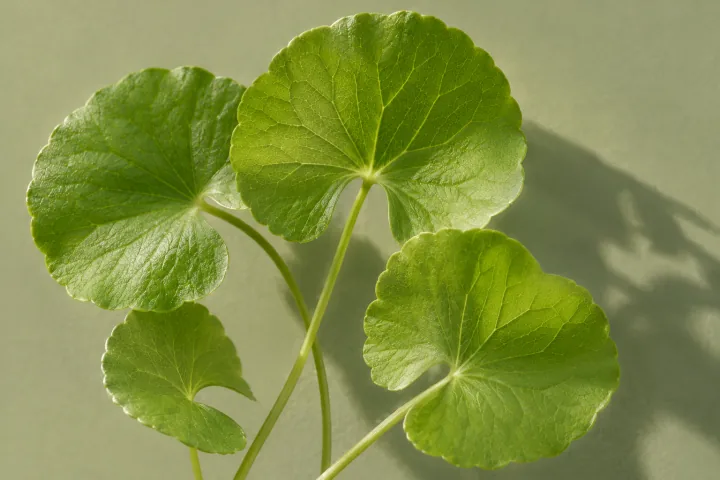
Centella asiatica is a plant. The dictionary defines Centella Asiatica Extract as an extract of the whole plant [1]. Madecassoside and asiaticoside are separate compounds with their own entries [3][4]. Cica is not an ingredient name. It is a marketing word for products built around the plant.
What Korean rules say
Centella is not among the brightening or wrinkle actives that Korea lets a product use without submitting efficacy data [5]. On its own, then, the ingredient gives a cosmetic no functional claim. A cica cosmetic is an ordinary cosmetic, and it may only make ordinary cosmetic claims.
The plant also appears in medicine. The MFDS drug database lists centella titrated extract (센텔라정량추출물) as an active ingredient in some over-the-counter drug ointments, combined with an antibiotic and approved for infected minor wounds [10], and in some quasi-drug (의약외품) ointments approved for supporting the treatment of wounds and skin ulcers [11]. Those approvals belong to those products. Article 13 of the Cosmetics Act bans cosmetic labels and ads that could be mistaken for medicine [6].
Claims a cica cosmetic may not make
These entries in the MFDS guideline [7] are the ones that come closest to how centella is often described. The guideline applies them to any cosmetic.
| Wording | Where the guideline puts it |
|---|---|
| Skin regeneration, cell regeneration (피부재생, 세포 재생) | Biological activity: mistaken for medicine |
| Anti-inflammatory, pain relief (항염·진통) | Medical effect: mistaken for medicine |
| Treating or restoring skin damaged by wounds or disease | Skin: mistaken for medicine |
| Removing scars left by wounds | Skin: mistaken for medicine |
| Improving or removing redness (홍조, 홍반) | Skin: mistaken for medicine |
| Relieving itching | Skin: allowed only as temporary relief of dryness-related itching through moisture |
In its online checks the MFDS has cited “skin regeneration”, “anti-inflammatory”, “reduces skin inflammation” and “helps relieve inflammation” among the phrases it found in breach [8][9]. Those checks covered cosmetics in general and did not single out cica products. The full phrase list is on the cosmetic ad claims page.
Cica in Korean product names
Centella sells under its own name. In the MFDS’s 2025 production statistics, the tenth-largest single product by production value was a sun serum with “centella” and “cica” in its name, at KRW 49.1 billion [12]. A name tells you the ingredient is there. It does not tell you how much, and it does not change what the product may claim.
What this page does not state
We have not opened research papers for this page, so it does not summarize what studies report about centella on skin.
Questions people ask
Is cica the same as centella asiatica?
Cica is a marketing name. On a Korean ingredient list, look for 병풀추출물 (Centella Asiatica Extract), 병풀잎추출물 (leaf extract) or compounds from the plant such as 마데카소사이드 (madecassoside).
Can a Korean cica cream say it heals or regenerates skin?
No. The MFDS guideline lists skin regeneration, treating skin damage and anti-inflammatory claims as wording that could make a cosmetic look like medicine, which Article 13 of the Cosmetics Act bans.
Is a centella ointment from a Korean pharmacy a cosmetic?
Not if its box says 일반의약품 (over-the-counter drug) or 의약외품 (quasi-drug). Those products are registered with approved uses. A cosmetic has neither label.
On the label
- Label name (INCI)
- Centella Asiatica Extract
- In Korean
- 병풀추출물
- Under Korean rules
- Ordinary cosmetic ingredient, listed as a skin conditioning agent. Not on the MFDS list of data-exempt brightening or wrinkle actives.
- Also called
- Cica, Centella, Gotu kola, Madecassoside, Asiaticoside
- Type
- Soothing
Sources
- ReferenceKorea Cosmetic Association ingredient dictionary: Centella Asiatica Extract
- ReferenceKorea Cosmetic Association ingredient dictionary: Centella Asiatica Leaf Extract
- ReferenceKorea Cosmetic Association ingredient dictionary: Madecassoside
- ReferenceKorea Cosmetic Association ingredient dictionary: Asiaticoside
- OfficialMFDS Regulation on the Review of Functional Cosmetics, Annex 4: functional cosmetics exempt from data submission (Korea Law Information Center)
- OfficialCosmetics Act, Articles 2 and 13 (Korea Law Information Center, version in force from October 20, 2026)
- OfficialMFDS: Guideline for Cosmetic Labeling and Advertising (화장품 표시·광고 관리 지침), revised August 14, 2025
- OfficialMFDS: “recommended by dermatologists”, “hospital-only” cosmetic ads found (May 23, 2025)
- OfficialMFDS: “skin regeneration”, “inflammation relief” cosmetic ads found (August 6, 2025)
- OfficialMFDS drug database (의약품안전나라): over-the-counter ointment record with centella titrated extract
- OfficialMFDS drug database (의약품안전나라): quasi-drug ointment record with centella titrated extract
- OfficialMFDS: 2025 cosmetics production, export and import statistics (May 22, 2026)